A recording of my reading at the 24th Trillium Book Award readings in June 2011.
And here’s Trillium winner Jeff Latosik’s lovely reading.
A recording of my reading at the 24th Trillium Book Award readings in June 2011.
And here’s Trillium winner Jeff Latosik’s lovely reading.
When working on a project, I often listen to a selection of songs on repeat, which helps me focus. If a particular section, sentence, or image is giving me pause, I sometimes cue up one song and hit repeat until the issue is resolved. This can mean one listen or 100. By the time a project is done, I’m left with a mixed tape of where I’ve been with the work. This, I suspected, was not unique. And so I’ve asked some writers to share their playlists.

Photo by Adam Wills
Music is an absolutely essential part of the writing process for me. I could not imagine working on DOOM successfully without an epic, supervillainous soundtrack.
Natalie’s Doom(ed) Playlist
(Click here to listen to the entire playlist on YouTube)
Iced Earth - Damian
By Your Command - Devin Townsend
Faith No More - Caffeine
Agalloch - Kneel To the Cross
Amorphis - Perkele
Gaza - He Is Never Coming Back
Devin Townsend - Planet Smasher
Gojira - Esoteric Surgery
Graf Orlock - Hauser
Isis - The Beginning And The End
Neurosis - Through Silver In Blood
Vader’s Imperial March - Star Wars Soundtrack
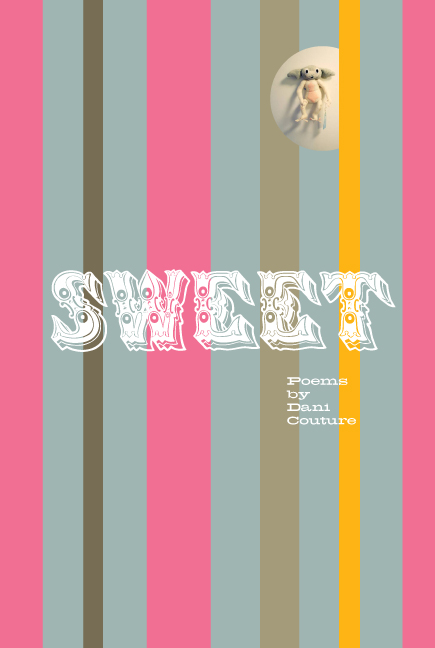
Sweet is listed as one of Maisonneuve’s Best Books of 2010.
Jacob McArthur Mooney interviewed me in June about Sweet. The interview now appears on Torontoist.
Toronto poet Dani Couture’s second collection, Sweet, is out this month from local poetry house Pedlar Press. The follow-up to Good Meat, her debut collection, Sweet is a step forward in both the poet’s ambition and her repertoire of control. In a book of short, specific poems that are sometimes generous and sometimes mean, Couture takes in everything from urban loneliness to hunting to insomnia. Dani is one of several Toronto poets who bring a distinctly rural outlook and ethic to their considerations of our city. The result is an ear for the social ecology of humans as tuned as the one for flight patterns of birds or the eating habits of a grizzly bear. Sweet is an excellent read: short, sweet, and constantly challenging.
Kerry Clare of Pickle Me This takes a look at Good Meat.
Couture’s collection has an unabashedly carnivorous theme–butchers, hunters, pumping hearts, frying bacon, fleshy girls, beef on a platter, and an exploding whale. Gaping wounds, gutted fish, Taiwanese mystery meat and the powers of e. coli…Her work is not raw (which I use here not as a pun, but raw is a reflex when discussing gutsy work like this) as much as medium rare–these poems are sculpted, worked-on, crafted. The imagery is as sharp as the knives that flash through them.
Julie Wilson, professional book fan, goes the distance for National Poetry Month and records three full-length book readings from three poets. The poets: Michael Lista, myself, and Susan Holbrook.
Mine went up today. My throat is still sore.
Listen in.
This year, I decided to extend that curious excess to full-blown athleticism by inviting three poets to read the entirety of their latest work. I went to them and we had some fun: in kitchens, in living rooms, on couches, in parks. Some poems clocked only 14 seconds, while others came in at over 19 minutes. While I’d like to think that we broke that wall together, for my part, I’ve absolutely mapped each performance as if a sponsored patch of highway, Dani Couture, Susan Holbrook, and Michael Lista each owning a length of my left and right forearms, which have only begun to stop vibrating.
Put away your magic 8 ball and tell your grandfather’s psychic you no longer need his services. Let the poets guide your next move.
During National Poetry Month, I will post three poetry fortune tellers.
Download them, print them, cut them, fold them, and find your fortune.
1. Mortiz, Robertson, Rogers, & Wright
2. Boxer, Degen, Holbrook, & Tranströmer
3. To be posted April 21, 2010.
If you forget how to fold one, here are some instructions.
The poetry fortune tellers have made some friends:
-“Introducing the Poetry Fortune Teller” — cancult.ca
-“Poetry Link: Dani Couture’s Poetry Fortune Teller” -Open Book Toronto
-“What can poetry tell you?” — The Indextrious Reader
- “No app. No Flash. Multitouch. Every publisher should build one of these. Now.” — Book Madam & Associates
- News for March 31 — The Poetry Foundation
- “Coolest Thing Ever” — Damian Rogers
Sina Queyras talks to jobber poets (including myself) on Harriet, the Poetry Foundation’s blog.
So, the lives of the poets. Or, the non-academic poets. I have known so many variations over the years. The organic farmer poet, the poet who compiles on scraps of paper and carries their poems in plastic bags. The poet who doesn’t work at all, the many versions of the mom poet that include the mom/crossing guard poet and the mom/teacher/organizer/arts promoter poet. There is a couple who alternate working and supporting each other every few years, and the poet who makes films. There are of course, many book store poets, and a few fishermen poets. I have not heard of an opera singing poet, or a surgeon poet, or an architect poet, though I have met doctor poets and lawyer poets. You get the idea.
Carey Toane and Elisabeth de Mariaffi want your quarters. Paul Vermeersch talks to Elisabeth about Toronto Poetry Vendors for Open Book Toronto.
Ten poets are packed into each machine, so ten different poems will be available for purchase. The broadsides are colour-coded. You know, like LifeSavers.
Concrete Trees and animal effigies. Poet Melanie Janisse talks about the red road, Joseph Boyden, a night we had out, and making maps out of napkins.
Boyden perfectly captures the disjointedness that occurs when one is willing to see through and past the constructs of the city. When as individuals we identify the effigy of trees that constitutes a city, and we begin to question the very concrete we live in.
Sima Rabinowitz reviews the fall 2009 issue of Grain Magazine for NewPages.
The theme of this issue is “Conversation,” which I understand to mean dialogue, relationship(s), images that reverberate and connect, and language in the service of vision, understanding, and meaningfulness. Editor Sylvia Legris traces the word’s roots to “the act of living with” or to keep company. Grain is all this and more.
…I’m reminded of Jacob McArthur Mooney‘s Globe and Mail post from the fall.
Mooney on the IFOA, poetry, and the Olympics:
“I feel a bit like an Olympic speed skater the day after the Olympics. The sun has shone on me and my kind for a couple of weeks, I’ve shared some of the attention given to more famous participants (for the Olympics, Sidney Crosby, for the IFOA, Orhan Pamuk), but now I go back to my dark practice rink and focus my attentions on the time in between. The time when nobody cares about speed skating, save for my fellow speed skaters and a hub of diehard fans. You want to say to those who came, heard you read, bought your book and said nice things, ‘You know, we do this stuff all the time, right? We don’t all go into cold storage the other 50 weeks of the year.'”
The original post, in its entirety, can be found here.